RETHINKING EDUCATION

Rethinking Humanity Begins with Rethinking Education.

Education should awaken human potential, develop intelligence, nurture talent and empower people to create meaningful value.

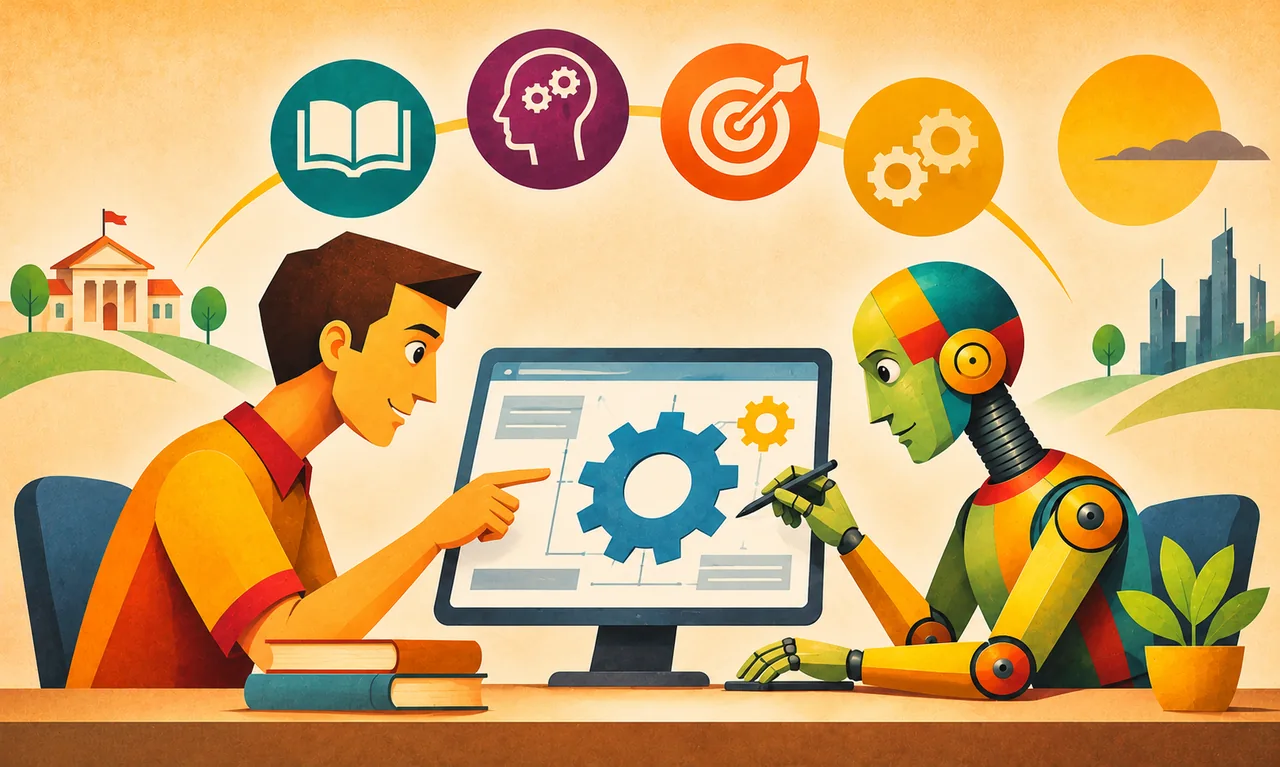
A human guides a colourful robot at a shared workspace, designing solutions with AI.

Yet much of our education system remains rooted in a model designed for a different age. Schooling often rewards memorisation and conformity. Higher education increasingly measures success through qualifications rather than competence.

The consequences extend beyond classrooms and campuses. Young people spend years acquiring degrees, only to discover that their qualifications do not always translate into meaningful opportunities. Artificial intelligence is making this disconnect more visible and more urgent.

The challenge is not simply to educate more people. It is to develop capable individuals who can think independently, solve problems and create sensible solutions.

THE EDUCATION CRISIS

More Qualifications. Less Realised Potential.

Education has expanded access to knowledge and qualifications. Yet three interconnected challenges reveal the limitations of systems that place too much emphasis on standardised outcomes.

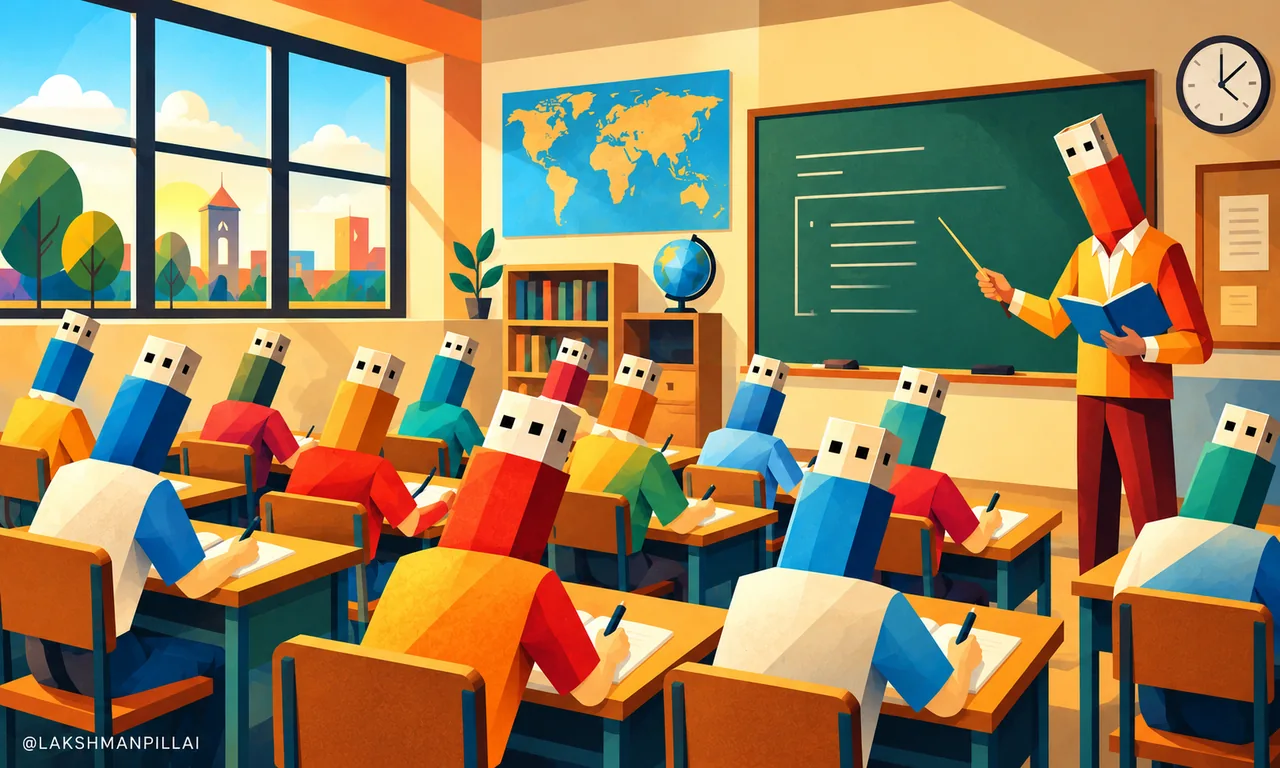
A classroom of USB-headed students and a USB-headed teacher, a metaphor for memorisation replacing independent thinking.

THE TRAGEDY OF SCHOOLING

When curiosity gives way to conformity.

Children enter school with curiosity, imagination and different ways of learning. Yet memorisation, uniformity and examinations can gradually overshadow questioning, exploration and independent thinking.

The tragedy is not that children fail to learn. It is that their potential to think independently, imagine possibilities and discover their capabilities may remain undeveloped.

Schooling should awaken intelligence, not standardise human potential.

EXPLORE THE TRAGEDY OF SCHOOLING
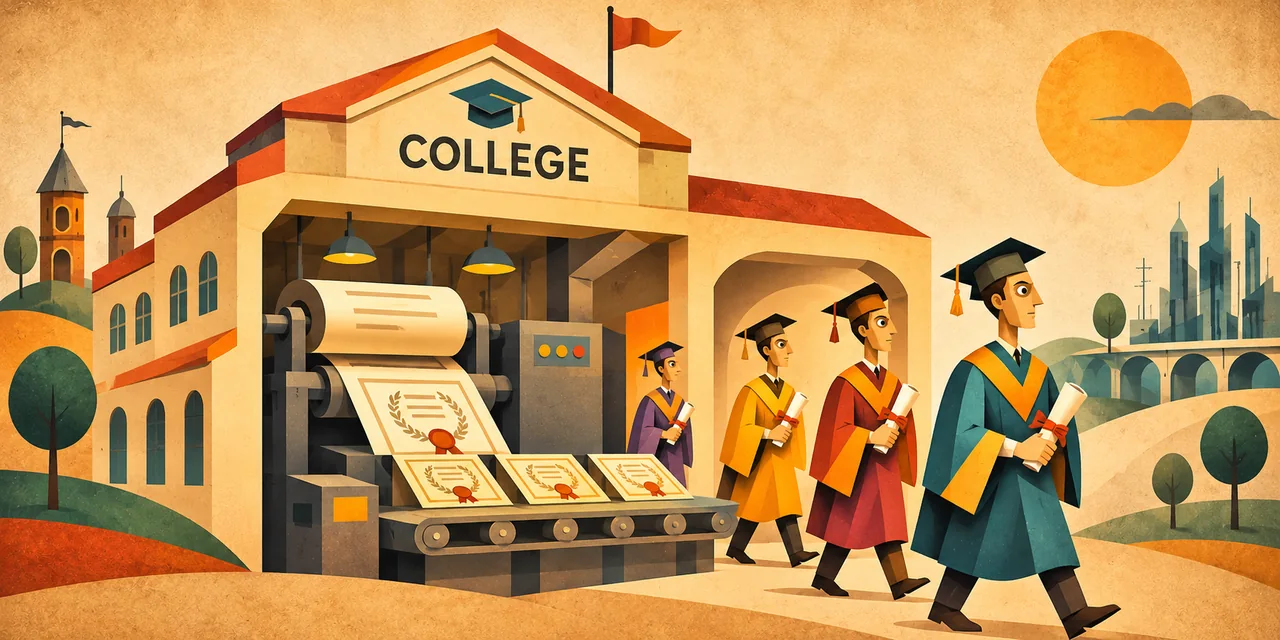
Graduates emerge from a college conveyor belt carrying degrees, illustrating qualification-driven education.

THE TRAGEDY OF HIGHER EDUCATION

The graduation-generating factory.

Higher education should develop expertise, advance knowledge and prepare young people to solve real problems. Yet many institutions focus heavily on admissions, examinations, pass percentages and degrees.

Students enter colleges with different talents and aspirations, move through standardised programmes and emerge with qualifications, often without sufficient opportunities to apply knowledge or develop meaningful competence.

The problem is not the degree itself. The tragedy begins when earning a degree becomes the destination rather than developing the competence to create value.

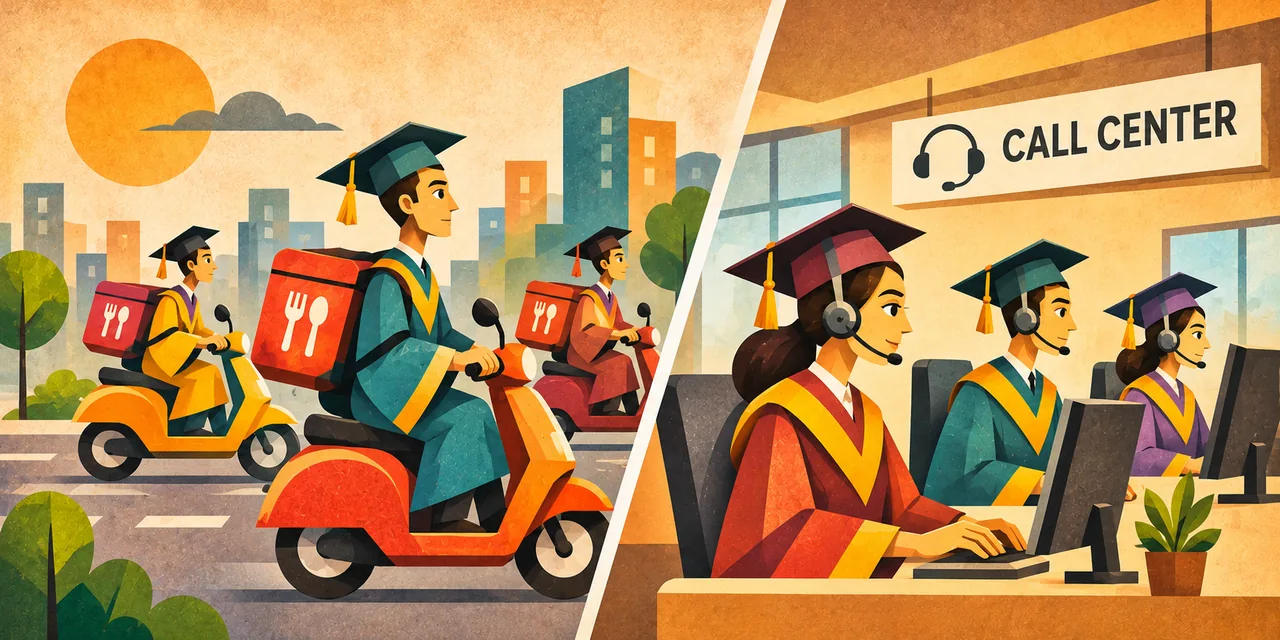
Graduates working in food delivery and a call centre, illustrating unrealised potential and underemployment.

THE TRAGEDY OF UNDEREMPLOYED YOUTH

Educated for years. Underprepared for opportunity.

An engineering graduate delivering food. A postgraduate working in a repetitive call centre role. A qualified young person moving between temporary jobs without meaningful opportunities to apply their education.

Every form of honest work deserves dignity and respect. The tragedy is not the work they do. It is the potential that remains unused.

Underemployment reflects a wider disconnect between education, competence, industry and economic opportunity. Creating more graduates without developing relevant capabilities and opportunities cannot solve this problem.

THE AI WAKE-UP CALL

When Machines Can Reproduce Knowledge, What Must Humans Become?

Artificial intelligence can retrieve information, explain concepts, generate content, write code and perform increasingly complex cognitive tasks. An education system centred primarily on memorising information and reproducing standard answers is becoming increasingly inadequate.

The answer is neither to compete with machines in routine tasks nor to surrender human thinking to technology. It is to develop the intelligence required to use technology wisely.

Students must learn to question assumptions, reason independently, imagine possibilities, exercise judgement and solve unfamiliar problems. They must also learn to identify meaningful problems, define objectives, guide AI towards useful outcomes and evaluate what is created.

Use AI to Learn. Use Human Intelligence to Guide AI in Creating. AI can accelerate learning and execution. Human intelligence must provide purpose, direction, creativity, judgement and responsibility.

The more capable machines become, the more important it is to develop capable human beings.

AI — ACCELERATE LEARNING AND EXECUTION

Access knowledge, analyse information, explore alternatives, generate possibilities and execute tasks efficiently.

HI — PROVIDE PURPOSE AND JUDGEMENT

Question assumptions, identify problems, imagine solutions, guide AI, evaluate outcomes and act responsibly.

RETHINKING SCHOOLING

From Standardised Learning to Awakened Human Potential.

Every child is different. Children possess different abilities, interests, learning needs and aspirations. Education should help them discover and develop their potential rather than force everyone towards identical outcomes.

Rethinking schooling means redesigning the learning environment to nurture curiosity, competence, character and the ability to solve problems.

AWAKEN CURIOSITY

Encourage children to question, explore, investigate and seek understanding rather than merely reproduce expected answers.

DEVELOP HUMAN INTELLIGENCE

Strengthen reasoning, critical thinking, imagination, creativity, problem-solving and independent judgement.

PERSONALISE LEARNING

Recognise individual strengths, interests and learning needs. Enable learners to progress through meaningful and flexible pathways.

LEARN THROUGH EXPERIENCE

Make experimentation, craft, music, movement and practical projects integral to education. Develop fine and gross motor skills through purposeful making, coordination and practice.

NURTURE THE WHOLE HUMAN

Develop empathy, dignity, responsibility, emotional maturity and physical self-awareness. Recognise bodily-kinesthetic capability alongside thinking and creativity, with accessible activities for different abilities.

BUILD PROBLEM-SOLVING CAPABILITY

Help children identify problems, understand causes, connect knowledge and create sensible solutions with awareness of their consequences.

CULTIVATE LIFELONG LEARNING

Develop the curiosity, confidence and adaptability to keep learning, unlearning and growing throughout life.

Schooling must move from standardised output to personalised, holistic development of human potential.

Thinking, moving and making belong together. Explore physical self-mastery, motor skills and bodily-kinesthetic capability as part of educating the whole person.

RETHINKING HIGHER EDUCATION

From Degree Production to Competence and Value Creation.

Higher education must evolve from a qualification-driven system into an ecosystem for developing competence, advancing knowledge, creating solutions and nurturing meaningful careers.

A university should be more than a place where students complete courses and receive degrees. It should be an environment where knowledge becomes capability, ideas become innovations and human potential becomes meaningful contribution.

MAKE COMPETENCE THE OUTCOME

Measure what students can understand, apply, design, develop and accomplish, rather than relying primarily on examination scores and certificates.

PERSONALISE CAREER DEVELOPMENT

Help students discover their abilities, explore emerging opportunities and build competencies aligned with their interests and aspirations.

CONNECT KNOWLEDGE WITH APPLICATION

Integrate practical projects, experimentation, research, real-world challenges and industry collaboration into learning.

DEVELOP PROBLEM SOLVERS AND CREATORS

Encourage students to identify unmet needs, question existing approaches, design products, develop technologies and create sensible solutions.

STRENGTHEN RESEARCH AND INNOVATION

Build institutions that advance knowledge, develop technologies, support experimentation and turn ideas into useful innovations.

LEARN AND CREATE WITH AI

Use AI to accelerate discovery, personalise learning and improve productivity while strengthening human reasoning, creativity and judgement. Students must guide AI, critically evaluate outputs and remain accountable.

BUILD A CONNECTED ECOSYSTEM

Connect educational institutions with industries, researchers, entrepreneurs and communities to align competency development with real needs and opportunities.

ENABLE EMPLOYABILITY AND ENTREPRENEURSHIP

Prepare graduates to contribute meaningfully in professional roles, adapt to changing industries, build enterprises and create opportunities for themselves and others.

The true measure of higher education is not how many graduates it produces, but how much human capability and value it creates.

THE EDUCATION WE MUST BUILD

Competent Individuals. Meaningful Careers. Enriched Humanity.

A transformed education system must pursue five interconnected outcomes.

COMPETENCY-DRIVEN

Develop knowledge, skills and human capabilities that can be applied to solve real problems.

PERSONALISED

Recognise individual talents, interests and aspirations, enabling each learner to develop through meaningful pathways.

HOLISTIC

Nurture intellectual, emotional, social, ethical and creative development, preparing individuals for life as well as work.

HIGH EMPLOYABILITY

Build relevant competencies, adaptability and professional capabilities while connecting education with emerging economic opportunities.

ENRICHED HUMANITY

Develop responsible individuals who use their intelligence, knowledge and technology to create value, strengthen society and improve human well-being.

These are not five isolated educational objectives. They are connected dimensions of an ecosystem designed to unleash human excellence.

FROM KNOWLEDGE TO WISDOM

Learn with AI. Think with HI. Create with Wisdom.

The future of education is not about choosing between human intelligence and artificial intelligence. It is about understanding their complementary strengths. AI can help people access knowledge, explore ideas, personalise learning, analyse information and execute complex tasks.

Human intelligence must identify what matters, question assumptions, define problems, imagine possibilities, exercise judgement and guide technology towards responsible outcomes.

The purpose of education must therefore extend beyond learning how to use AI. It must develop the intelligence to know what to create, why it matters, how to create it sensibly and whom it should benefit.

Technology can amplify our capabilities. Wisdom must guide how we use them.

THE WAY FORWARD

Education Must Awaken Human Potential.

A nation does not become wiser merely by building more schools, establishing more universities or producing more graduates. It progresses when education develops people who can think independently, discover their potential, solve problems, build enterprises, advance technologies and contribute responsibly to society.

The future of education cannot be another version of the same factory model, enhanced with digital devices and artificial intelligence. Technology can transform how education is delivered. But only a transformation in purpose can change what education achieves.

  • memorisationTOunderstanding
  • conformityTOcuriosity
  • standardisationTOpersonalisation
  • examinationsTOcompetence
  • degreesTOcapabilities
  • job seekingTOvalue creation
  • information accumulationTOhuman intelligence
  • technological dependenceTOhuman excellence

Education must not simply prepare people to fit into the world as it exists. It must empower them to question what exists, imagine what is possible and create a better world.

Rethinking Humanity Begins with Rethinking Education.

The future of humanity is not just about what machines can become. It is about what humans must become.

EXPLORE OUR VISION